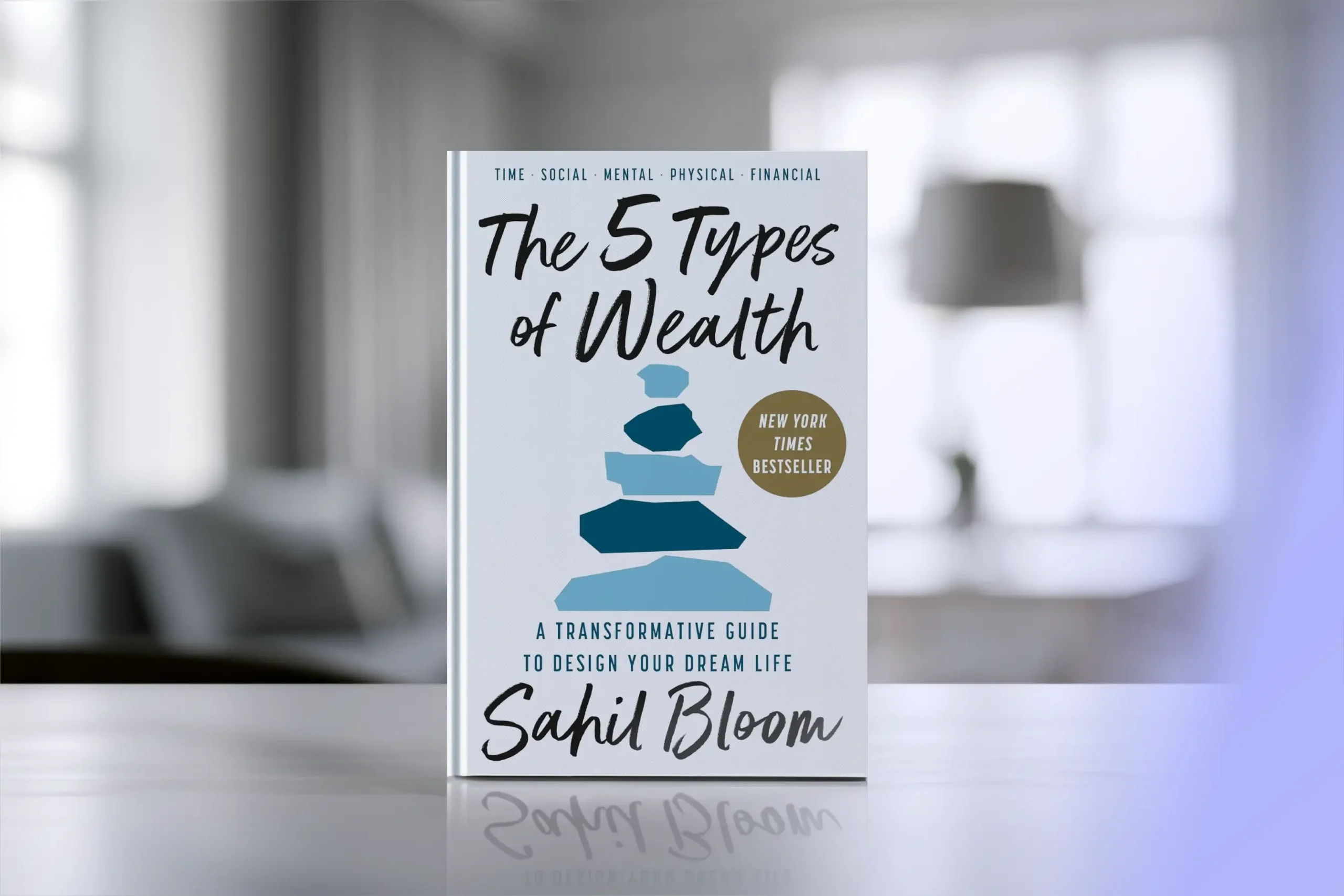
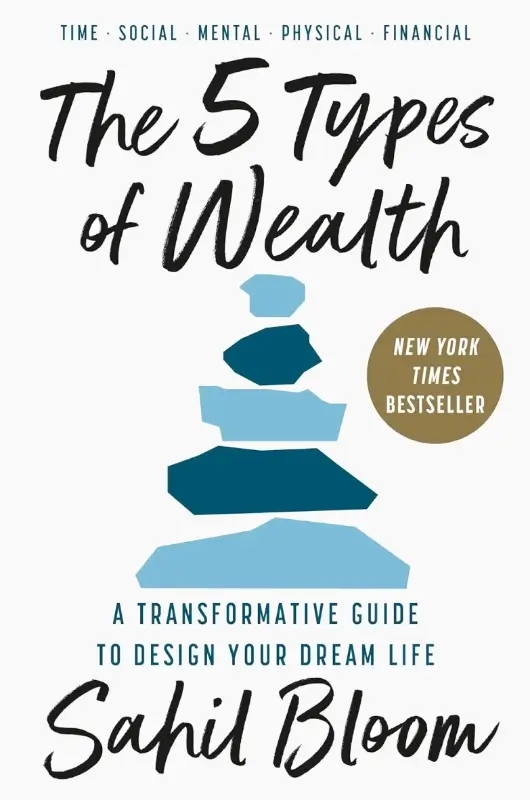
In “The 5 Types of Wealth”, Sahil Bloom challenges the traditional definition of success, arguing that true wealth extends beyond money and is built across five interconnected dimensions: Time Wealth, Social Wealth, Mental Wealth, Physical Wealth, and Financial Wealth.
Combining personal stories, research, and practical frameworks, Bloom provides readers with a holistic approach to designing a more meaningful and balanced life. This review examines each section of the book and explores how effectively Bloom delivers on his goal of redefining what it means to be wealthy.
Core Concepts
The book introduces several key ideas that form the foundation of Sahil Bloom’s theory:
- Financial Wealth: Building and managing money, assets, and financial security as one pillar of a richer life — not the only one.
- Time Wealth: Taking ownership of how you spend your hours, eliminating obligations that drain energy, and protecting time for what matters most.
- Social Wealth: Cultivating deep, meaningful relationships and a community that genuinely supports your growth and happiness.
- Mental Wealth: Developing your inner world — mindset, psychological resilience, clarity, and freedom from limiting beliefs.
- Physical Wealth: Treating your body as your most valuable long-term asset through movement, nutrition, sleep, and energy management.
Bloom argues that these five dimensions are not in competition — investment in one consistently amplifies the others, creating a virtuous cycle of genuine abundance.
Chapter-by-Chapter Review
Part I: Designing Your Dream Life
The opening section reframes wealth as a holistic concept and challenges the default assumption that financial success alone defines a good life. Bloom introduces the Five Types of Wealth framework—Time, Social, Mental, Physical, and Financial—and invites readers to rethink success, clarify what they truly value, and design a life that balances these dimensions across different seasons of life. He offers reflective questions and practical prompts that help readers audit their current life and make more intentional decisions that support all five types of wealth, not just money.
Part II: Time Wealth
In the Time Wealth section, Bloom presents time as a finite and uniquely precious asset, emphasizing that true richness includes autonomy over how you spend your hours and days. He encourages readers to cultivate awareness of time’s scarcity, direct their attention toward what matters most, and gain greater control over their schedules and commitments. The section offers concrete ideas for redesigning your calendar around meaningful work, relationships, and restorative activities rather than default obligations and busyness.
Part III: Social Wealth
The Social Wealth section explores the depth and breadth of your relationships as a core pillar of a rich life. Bloom highlights the importance of deep, meaningful bonds with family and close friends, as well as broader communities and networks that provide support, belonging, and earned trust over time. He encourages readers to intentionally invest in relationships, build communities, and cultivate a reputation grounded in reliability and contribution, arguing that long‑term fulfillment depends heavily on the people around you.
Part IV: Mental Wealth
In Mental Wealth, Bloom focuses on inner life: purpose, curiosity, psychological well‑being, and the space to think. He frames mental wealth as having a guiding vision, a commitment to growth, and protected space for reflection, learning, and listening to your inner voice, rather than merely chasing external markers of success. The section encourages readers to nurture their “inner child,” build resilience, and align their choices with a clearer sense of meaning so that achievements feel satisfying rather than hollow.
Part V: Physical Wealth
The Physical Wealth section positions health, energy, and longevity as foundational enablers of every other type of wealth. Bloom emphasizes sustainable habits around movement, strength, nutrition, sleep, and recovery so that you can continue doing the activities you love and remain physically capable later in life. He invites readers to treat their bodies as long‑term investments, showing how better physical health expands your capacity to enjoy time, relationships, meaningful work, and financial opportunities.
Part VI: Financial Wealth
In the Financial Wealth section, Bloom treats money as an important but incomplete component of a rich life, reframing it as a tool to support freedom and security rather than an end in itself. He focuses on defining what “enough” looks like, building income through valuable skills, managing expenses to avoid lifestyle inflation, and investing for the long term to move beyond trading time directly for money. Throughout, he argues that financial wealth should be designed to reinforce time, social, mental, and physical wealth, not crowd them out.
Key Strengths
- Fresh and Compelling Reframing: Provides a genuinely new lens on success that challenges conventional wisdom without dismissing the importance of financial security.
- Actionable at Every Stage: Each concept is paired with concrete exercises and habit frameworks you can begin implementing immediately.
- Authentic and Vulnerable: Bloom writes from real experience — including his own failures — which makes the advice feel earned rather than theoretical.
- Integrative Systems Thinking: Shows clearly how the five wealth types interact and reinforce each other, preventing the siloed thinking most self-help books encourage.
- Accessible and Quotable: Dense with memorable insights that make the framework easy to internalise, share, and return to over time.
Potential Drawbacks
- Breadth Over Depth: Covering five major life dimensions in one book means some areas receive lighter treatment than dedicated specialist titles can offer.
- Familiar Genre Conventions: Readers well-versed in personal development literature will recognise the structure; the framework is the differentiator, not the format.
- Primarily Western Perspective: Some examples and cultural references reflect Bloom’s American background, which may feel less immediately applicable to international readers.
Who This Book Is For
This book is a valuable resource for a wide range of readers, particularly:
- High achievers who feel successful on paper but privately unfulfilled.
- Anyone at a career crossroads or life transition looking to make a more intentional next move.
- Those who want a clear, integrated framework for designing a life — not just a career.
- Anyone who has read financial or productivity books who feels they are still missing purpose.
Final Review
“The 5 Types of Wealth” is one of 2025’s most significant personal development books. A clear-eyed, compassionate challenge to the way most of us have been conditioned to measure success. Sahil Bloom has synthesised years of research, personal experience, and direct conversations with hundreds of thousands of readers into a framework that feels both genuinely fresh and immediately actionable. Whether you’re optimising your career, rebuilding after a setback, or simply questioning whether the life you’re building is the one you actually want, this book gives you a new map and the tools to follow it.
Rating: 4.8/5
The redefinition of success and essential reading for anyone ready to build wealth in every dimension of their life.
Alternative Books
Here are three personal growth books that you may want to explore:
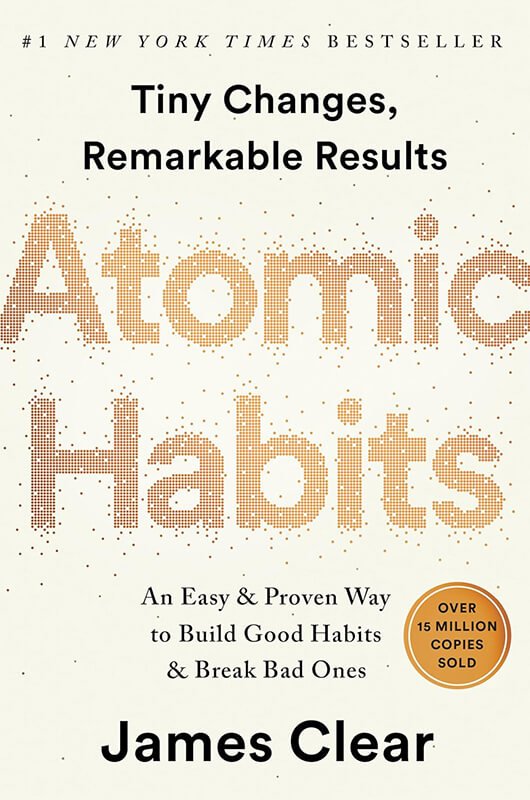
“Atomic Habits” by James Clear
The definitive guide to building good habits and breaking bad ones through tiny, compounding improvements that reshape your identity over time.
Rating: 4.9/5
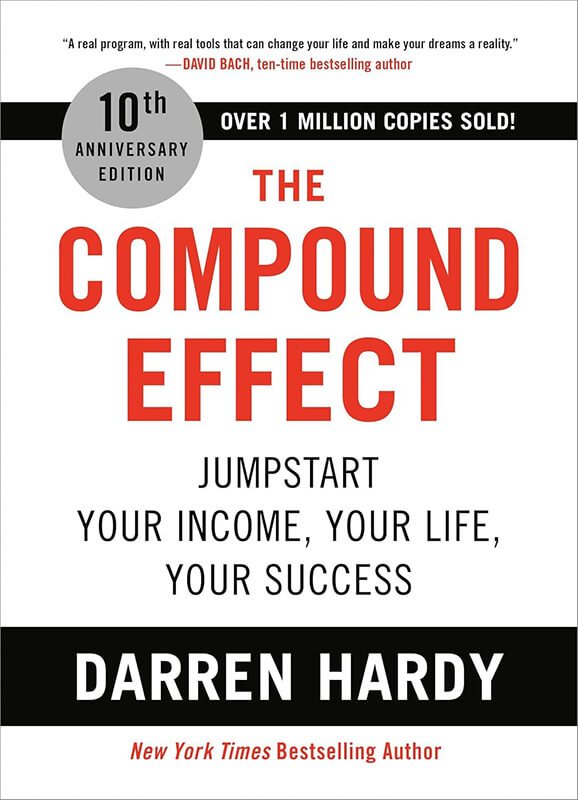
“The Compound Effect” by Darren Hardy
A practical guide to harnessing the power of small, consistent choices that compound over time into extraordinary results in every area of life.
Rating: 4.6/5
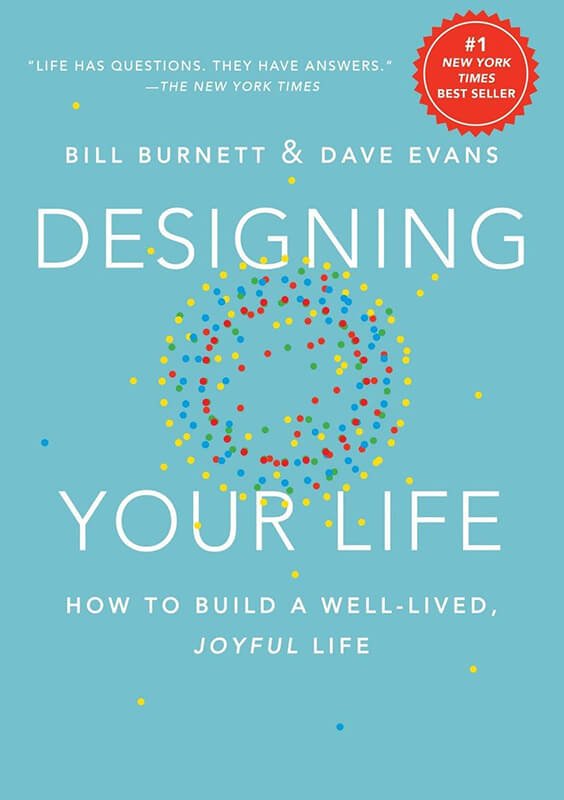
“Designing Your Life” by Bill Burnett & Dave Evans
A Stanford design-thinking approach to building a life you love — ideal for anyone ready to prototype and iterate their way to greater purpose and fulfilment.
Rating: 4.5/5