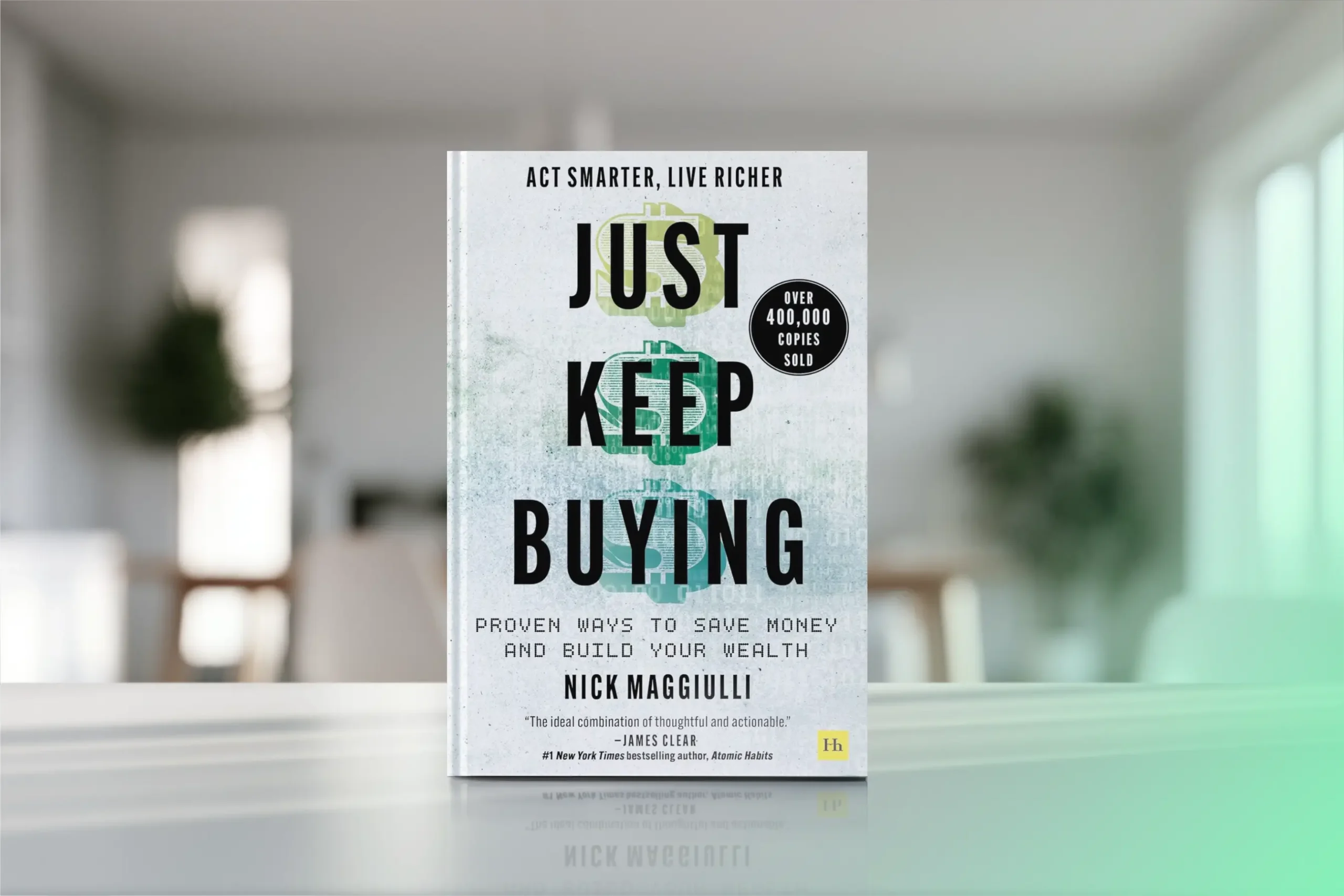
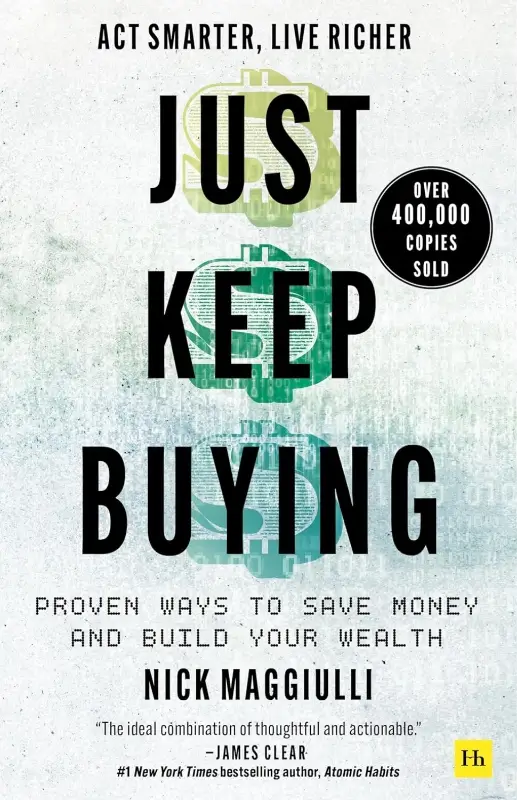
Nick Maggiulli‘s “Just Keep Buying” challenges the idea that successful investing depends on perfect timing, prediction, or complex optimisation, arguing instead that consistent saving and steady investing are the true drivers of long-term wealth, first published in 2022.
As COO and Data Scientist, Maggiulli draws on historical market data and behavioural finance research to show that simplicity and consistency tend to outperform attempts at precision.
Core Concepts
The book is built around a set of durable, behaviour-focused principles:
- Save What You Can: There is no universal savings rate — savings should reflect income level, obligations, and life stage rather than fixed rules.
- Just Keep Buying: Consistent investing over time is more reliable than attempting to time market entry points.
- Time in the Market Over Timing the Market: Long-term participation matters more than short-term prediction.
- Behaviour Over Complexity: Financial outcomes are driven more by consistency and discipline than optimisation or technical sophistication.
- Income as a Key Driver: Increasing earning power is often one of the most powerful levers for long-term wealth building.
Together, these principles shift personal finance away from prediction and towards repeatable behaviour.
Chapter-by-Chapter Review
Part I: Saving
The saving section challenges rigid financial rules around budgeting, debt, and lifestyle choices. Instead of fixed formulas, Maggiulli emphasises flexibility — what you save, spend, and prioritise should be shaped by your actual circumstances rather than arbitrary benchmarks.
Spending is reframed as compatible with wealth building when aligned with personal values, while lifestyle inflation is treated as a neutral force that can be either harmful or healthy depending on context. Debt is discussed as a financial tool whose impact depends on structure and purpose rather than a universal rule of avoidance. Major decisions such as renting versus buying are evaluated using data rather than ideology, reinforcing the idea that outcomes vary widely based on individual situations.
This section ultimately argues that financial stability is less about strict optimisation and more about building a sustainable system that adapts as your income and life evolve.
Part II: Investing
Maggiulli makes a strong case for diversified investing over individual stock picking. In “Why You Shouldn’t Buy Individual Stocks,” he argues that most investors are unlikely to outperform broad indices, while acknowledging exceptions such as experienced professionals, founders with concentrated equity, or skilled active managers. The point is framed as probabilistic rather than absolute.
Market timing strategies, including waiting to “buy the dip,” are shown to be unreliable and often harmful to long-term returns. The book also highlights the role of luck in outcomes, showing that even good decisions can produce varied results in the short term.
Volatility is reframed as a normal part of investing, and readers are encouraged to stay invested through downturns, avoid emotional selling, and consider tax-efficient investing structures.
A key behavioural insight, “Why You Will Never Feel Rich,” explores the gap between rising wealth and subjective financial satisfaction.
The section closes with “The Most Important Asset,” emphasising human capital — skills, knowledge, and earning ability — as the primary driver of long-term wealth, with practical focus on improving skills and increasing income potential over time.
Key Strengths
- Data-Driven Clarity: Every recommendation is backed by historical evidence, removing guesswork and replacing it with grounded, repeatable guidance.
- Behavioural Focus: The book targets the psychological barriers that derail most investors, fear, impatience, and overconfidence, with practical, actionable solutions.
- Accessible Writing: Maggiulli translates complex financial concepts into plain language without sacrificing depth or intellectual rigour.
- Flexible Framework: Rather than prescribing rigid rules, the book adapts its advice to different income levels, life stages, and financial goals.
- Broad Coverage: From saving and spending to debt, housing, and investing, the book addresses the full financial picture rather than a single slice of it.
Potential Drawbacks
- US-Centric Assumptions: Tax vehicles, account types, and market references are heavily weighted towards a US audience, which limits direct applicability for international readers.
- Limited Advanced Strategies: Readers with established portfolios or complex financial situations may find the advice too foundational to move the needle for them.
- Repetition of Core Message: The central “just keep buying” principle is reinforced throughout, which some readers may find repetitive across the book’s full length.
Who This Book Is For
This book is a valuable resource for a wide range of readers, particularly:
- Beginners and early investors building long-term wealth
- Professionals overwhelmed by conflicting financial advice
- Anyone tempted to time the market or wait for the “perfect” moment
- Readers interested in the psychology behind money decisions
Final Review
“Just Keep Buying” is a clear, data-driven guide to building wealth through consistency rather than complexity. Maggiulli’s central message is simple but powerful: successful financial outcomes come from staying invested, saving steadily, and resisting the temptation to overthink timing or optimisation. For anyone overwhelmed by conflicting financial advice or stuck waiting for ideal market conditions, this book offers a grounding alternative — stop trying to predict, and start participating.
Rating: 4.7/5
A practical, evidence-based guide to saving and investing that replaces financial overthinking with consistency, discipline, and long-term execution.
Alternative Books
Here are three related books that further explore this topic:
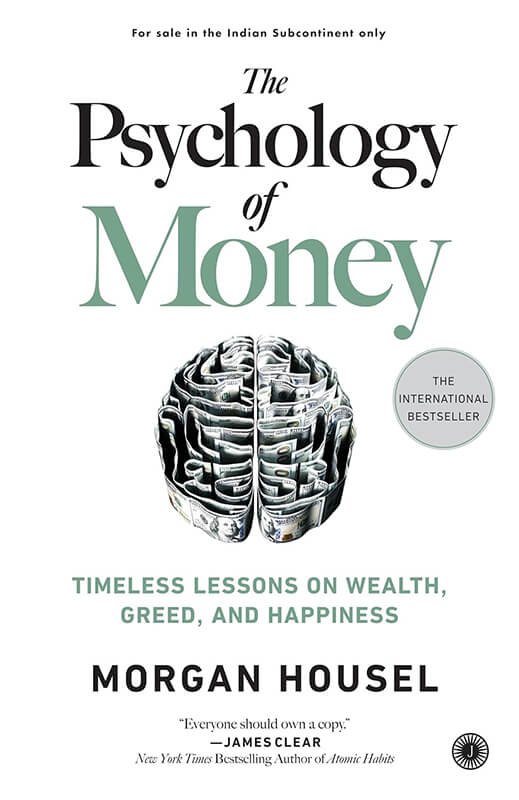
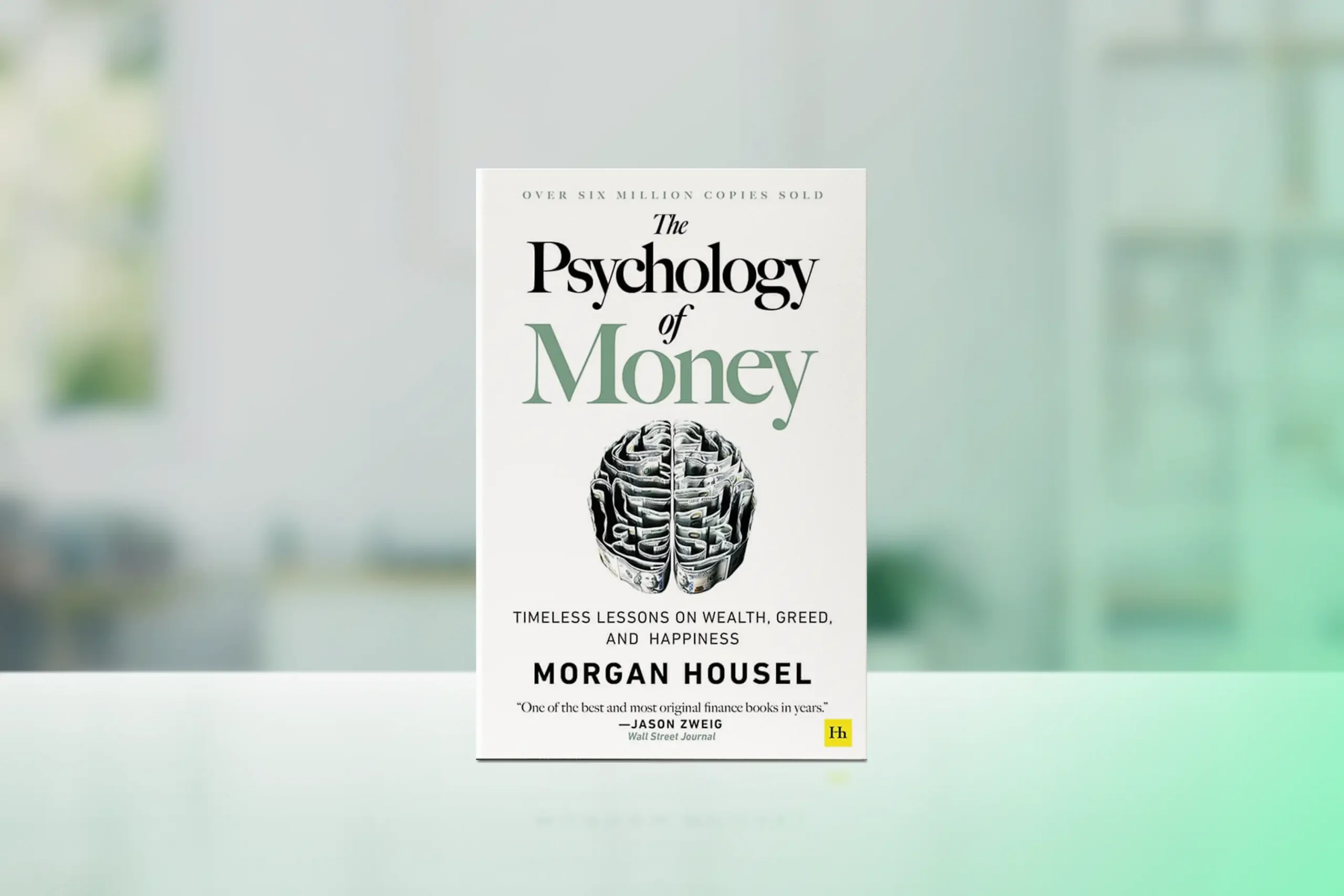
“The Psychology of Money” by Morgan Housel
Morgan Housel explores how behaviour, emotion, and mindset shape financial outcomes far more than knowledge or intelligence alone.
Rating: 4.7/5
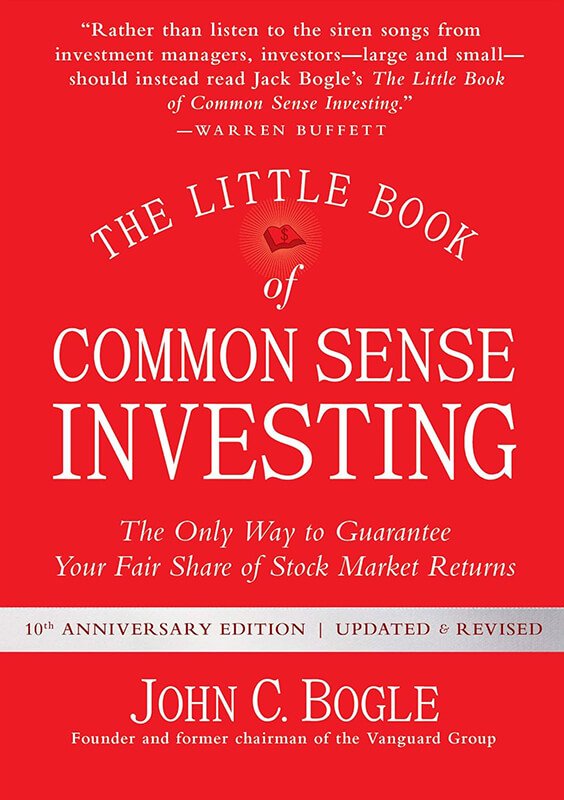
“The Little Book of Common Sense Investing” by John C. Bogle
John C. Bogle makes the definitive case for low-cost index fund investing as the most reliable path to long-term wealth for the everyday investor.
Rating: 4.7/5
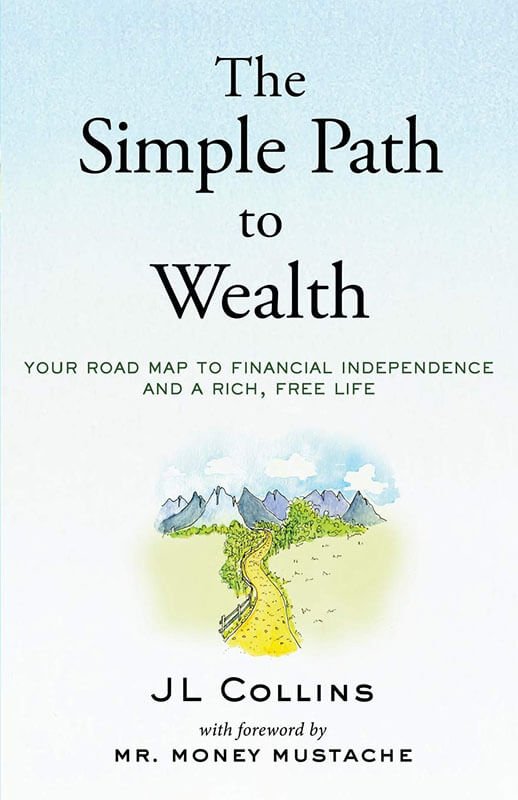
“The Simple Path to Wealth” by JL Collins
JL Collins delivers a no-fuss blueprint for financial independence built on index fund investing, low expenses, and staying the course through market volatility.
Rating: 4.6/5