
Most personal development frameworks fail for one simple reason: they focus on what to do without addressing how change actually works. You set goals, feel motivated for a few weeks, then watch your progress fade. Sound familiar?
The Empower Process takes a different approach. It combines the psychology of habit formation with a structured 10-week cycle designed to create permanent transformation, not temporary motivation. We’ve spent the last few years studying what works, testing what doesn’t, and refining this framework to give people a realistic, repeatable system for lasting change.
Inside this article:
What Is The Empower Process?
A seven-phase, 10-week system for building lasting habits. The acronym E M P O W E R stands for:
Explore → Understand where you are right now
Mission → Clarify why this change really matters
Plan → Map out what you will do next
Optimize → Design your environment to support success
Work → Show up and do the work consistently
Evolve → Adapt based on what you learn
Reflect → Review what happened and prepare for the next cycle
The structure is designed around the 66-day mark when research shows behaviors become automatic. Ten weeks gives you the runway to cross that threshold and lock the habit into your identity.

1. Why Most Frameworks Fall Short
The personal development space is crowded with frameworks, systems, and methodologies. Some have stood the test of time. Others fade as quickly as the motivation they promise.
Popular frameworks like SMART goals and the GROW model have their place:
- SMART helps you define clear objectives
- GROW provides a useful coaching conversation structure
But neither addresses the fundamental challenge of personal change: making new behaviors stick.
James Clear’s Atomic Habits revolutionized how we think about behavior change. His insight that we should focus on systems rather than goals, and that identity drives behavior, shifted the conversation in the right direction. But while Atomic Habits provides the philosophy and mechanics, it doesn’t offer a structured timeline for implementation. You understand why habits work, but you’re left to figure out how to structure your transformation.
David Allen’s Getting Things Done (GTD) remains the gold standard for productivity and task management. Its capture-clarify-organize-reflect-engage workflow is elegant and effective. But GTD is designed for managing work, not transforming who you are. It helps you do more, not become more.
Stephen Covey’s 7 Habits of Highly Effective People offers timeless principles for personal effectiveness. Begin with the end in mind. Put first things first. These concepts resonate deeply. But principles aren’t actionable steps. Knowing you should “sharpen the saw” doesn’t tell you how to actually build the habit of continuous improvement.
The 12 Week Year by Brian Moran brought urgency to goal-setting by compressing annual goals into 12-week sprints. The shorter timeframe creates focus and accountability. But the intensity can lead to burnout, and the framework doesn’t account for the 66 days research shows we need to form lasting habits.
75 Hard by Andy Frisella built discipline through strict rules: two workouts daily, a diet with no cheat meals, no alcohol, reading 10 pages, drinking a gallon of water. For 75 days. No exceptions. The program builds mental toughness, but its all-or-nothing approach means one slip resets everything. Real life rarely accommodates such rigidity.
Research from University College London found that it takes an average of 66 days for a new behavior to become automatic. Yet most frameworks ignore timing entirely. They tell you what to aim for without giving you a realistic structure for getting there.
The result?
- You start strong
- You hit resistance around week three
- You abandon your goals by month two
The framework didn’t fail. It was never designed for how humans actually change.
Key Insight: Most frameworks excel at one thing — goal clarity, task management, or habit mechanics — but none integrate timing, systems, and iteration into a complete process. That gap is why people keep starting over.

2. How The Empower Process Was Developed
The Empower Process didn’t emerge from theory alone. It came from studying what works across dozens of established frameworks, identifying what’s missing, and synthesizing the best elements into a cohesive system.
From Design Thinking, we borrowed two key insights: discover the right problem before rushing to solutions, and use iterative loops — prototype, test, learn, repeat. The Foundations phase embeds the first. The W → E → R engine embeds the second.
From Atomic Habits, we took the emphasis on identity-based change and the understanding that small actions compound over time. The Empower Process builds toward identity in its final phase — you’re not just doing the habit, you’re becoming the person who does it automatically.
From GTD, we borrowed the importance of capture and clarify before action. The Explore and Plan phases ensure you’re not just busy, but working on what actually matters.
From The 12 Week Year, we adopted the power of compressed timeframes that create urgency without overwhelm. Ten weeks is long enough for real transformation but short enough to maintain focus.
From the GROW model, we integrated the value of starting with current reality (Explore) before jumping to goals (Mission), and the importance of exploring options (Optimize) before committing to action (Work).
From Kaizen, we embraced continuous small improvements. The Evolve phase ensures you’re not rigidly following a plan that isn’t working — you adapt as you learn.
From habit research, we structured everything around the 66-day threshold. The 10-week (70-day) cycle isn’t arbitrary. It’s designed so that your new behavior crosses into automatic territory right before completion.
What none of these frameworks provided was a complete system that integrates:
- Discovery before decision (knowing you’re solving the right problem)
- Assessment before action
- Systems design before execution
- Structured timing aligned with habit science
- Iterative loops that compound learning
- Reflection to close each cycle and inform the next
The Empower Process fills that gap.
Key Insight: We didn’t invent new ideas — we synthesized proven ones into a single, cohesive system. The Empower Process takes what works from Design Thinking, Atomic Habits, GTD, and habit research, then structures it around realistic timing.

3. The Empower Process
The Empower Process is a seven-phase process that guides you from initial awareness to lasting transformation. Each phase builds on the previous one, creating momentum that compounds over time.
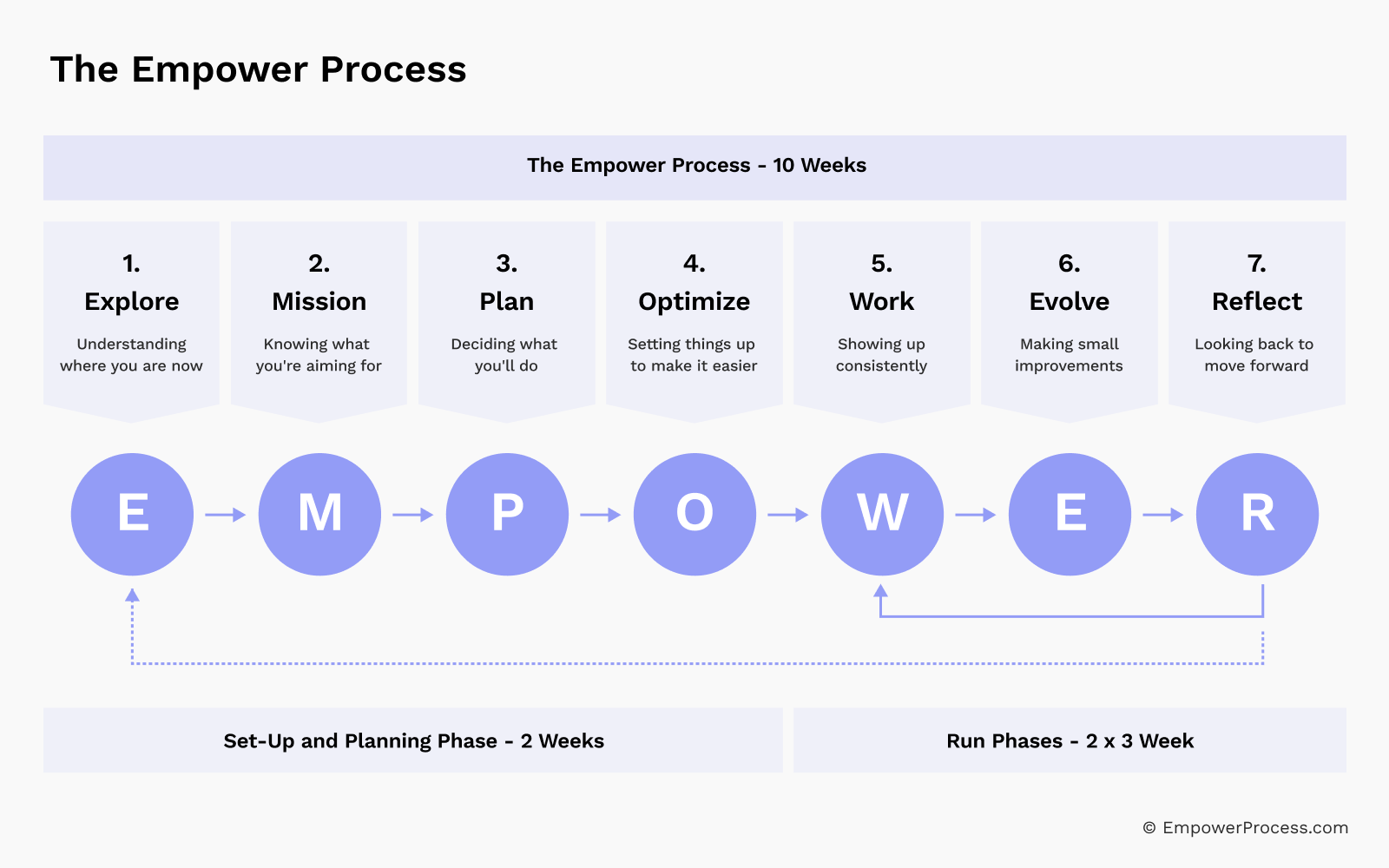
The Empower Process runs over 10 weeks (70 days). The first two weeks focus on preparation and planning—getting clear on what you’re changing and setting up the systems that will support it. The remaining eight weeks are dedicated to consistent execution and gradual adjustment, allowing the habit to develop and strengthen over time.
| Phase | Focus | Key Question | Week(s) |
|---|---|---|---|
| Explore | Understanding where you are now | What’s my current situation, honestly? | Week 1 |
| Mission | Knowing what you’re aiming for | Why do I want to do this right now? | Week 1 |
| Plan | Deciding what you’ll do | What am I going to work on? | Week 2 |
| Optimize | Setting things up to make it easier | How can I remove friction and obstacles? | Week 2 |
| Work | Showing up consistently | Did I do the work today? | Weeks 3-10 |
| Evolve | Making small improvements | What should I adjust based on what happened? | Weeks 3-10 |
| Reflect | Looking back to move forward | What did I learn that I’ll use next time? | Weeks 3-10 |
Research shows that behaviors typically become automatic around the 66-day mark. Ten weeks provides enough runway to cross that threshold, so the habit doesn’t just exist—it becomes part of who you are.
Key Insight: The seven phases aren’t just steps — they’re a sequence that respects how change actually happens. Foundation first, execution second, reflection to close the loop.

4. The Seven Phases Explained
Each phase of the Empower Process serves a specific purpose in your transformation journey. Skip one, and the whole system weakens. Master each, and they build on one another to create lasting change. Here’s what happens in each phase and how to make it work for you.
E — Explore
Get curious about where you actually are. Look at your life without judgment. Examine your habits, beliefs, results, and patterns. Understand what’s working, what’s not, and why. This is about truth, not wishful thinking. Most people skip this step and pay for it later.
- Rate each area of your life from 1-10 and write down why
- Track how you actually spend your time and money for one week
- List the habits you do on autopilot — which serve you, which don’t?
- Ask someone who knows you well: what patterns do they see?
- Write down what you’ve tried before and why it didn’t stick
Key Insight: You can’t change what you don’t understand. Explore forces honesty before action, so you’re solving the right problem from the start.
M — Mission
Define what matters to you — not what should matter. Connect to your values and the deeper reason behind wanting change. Without a clear why, motivation fades when things get hard. Your mission becomes the anchor that keeps you grounded when resistance shows up.
- Complete the sentence: “This matters to me because…” and go five levels deep
- Describe your life in vivid detail after this change has stuck
- Identify what you’ll lose if you don’t make this change
- Write a one-sentence mission you can recite when things get hard
- Check: does this align with who you want to be in five years?
Key Insight: Motivation fades. Mission endures. When week three gets hard, your mission is what pulls you forward — not willpower.
P — Plan
Translate your mission into a concrete path. Set specific goals, break them into milestones, and decide what you’ll actually do. A plan without clarity is just a wish. The goal isn’t perfection — it’s having a clear enough direction to start moving.
- Define exactly what success looks like in measurable terms
- Map out week-by-week milestones for the full 10 weeks
- Choose one daily action that takes 30 minutes or less
- List your top three likely excuses and pre-decide your response
- Write your entire plan on a single page — if it’s longer, simplify
Key Insight: A good plan is simple enough to follow and specific enough to measure. If you can’t explain it in one page, it’s too complicated.
P — Plan
Translate your mission into a clear plan. Set specific goals, break them into milestones, and decide what you’ll actually do. A plan without clarity is just a wish. The goal isn’t perfection — it’s having a clear enough direction to start moving.
- Define exactly what success looks like in measurable terms
- Map out week-by-week milestones for the full 10 weeks
- Choose one daily action that takes 30 minutes or less
- List your top three likely excuses and pre-decide your response
- Write your entire plan on a single page — if it’s longer, simplify
Key Insight: A good plan is simple enough to follow and specific enough to measure. If you can’t explain it in one page, it’s too complicated.
O — Optimize
Design your environment and systems to support your plan. Remove friction from good behaviors, add friction to bad ones. Build structures that make success easier than failure. Willpower is unreliable — your environment should do the heavy lifting so you don’t have to.
- Place the tools you need where you can’t miss them
- Remove or hide the one thing that typically derails you
- Attach the new habit to something you already do every day
- Set calendar blocks, phone reminders, or visual cues
- Tell one person your plan and ask them to check in weekly
Key Insight: Don’t rely on willpower — engineer your environment. The goal is to make the right choice the easiest choice.
W — Work
Show up and do the work, day after day. This phase is about execution — small daily actions compounded over time. No hacks, no shortcuts. Just the work. The previous phases prepared the ground. Now you plant seeds every single day and trust they’ll grow.
- Do the action at the same time each day — remove the decision
- Aim for “good enough” daily rather than “perfect” occasionally
- Track with a simple method — a calendar with X’s works fine
- Block the time and defend it like your most important meeting
- Count the streak, not the results — early wins come from showing up
Key Insight: Don’t rely on willpower — engineer your environment. The goal is to make the right choice the easiest choice.
E — Evolve
Adapt as you learn. What worked at the start may not work later. Stay flexible, experiment, and let yourself grow beyond your original plan. Rigidity kills progress. The goal isn’t to follow the plan perfectly — it’s to reach the destination, adjusting as needed.
- At the end of each week, ask: what made this easier? What made it harder?
- Change one variable at a time — time, location, duration, or method
- If something fails three times, drop it and try a different approach
- Notice when the habit starts feeling easier — that’s progress
- Update your plan every two weeks based on what you’ve learned
Key Insight: Your first plan won’t be perfect — and it doesn’t need to be. Evolve treats adjustment as part of the process, not a sign of failure.
R — Reflect
Step back and assess. What happened? What did you learn? What needs to change? Reflection closes the loop and sets up the next cycle of growth. Without reflection, you repeat mistakes. With it, every cycle makes you sharper and more effective.
- Compare where you are to where you planned to be — data, not judgment
- Write down one thing that worked and one thing that didn’t
- Acknowledge your consistency, not just your outcomes
- Make a keep / change / stop list for the next cycle
- Set one clear intention before moving into the next phase
Key Insight: Reflection turns experience into wisdom. Without it, you just repeat cycles. With it, each cycle compounds on the last.

5. The 10-Week Structure
The seven phases are distributed across a 10-week cycle, divided into three stages.
| Stage | Weeks | Phases | Focus |
|---|---|---|---|
| Foundations | 1–2 | E → M → P → O | Building the system. Setting things up so progress is easier |
| Momentum | 3–6 | W → E → R | Forming the habit. Building consistency and routine |
| Mastery | 7–10 | W → E → R | Cementing the habit. Making it part of who you are |
The 10-week structure isn’t arbitrary — it’s designed so you cross the 66-day automaticity threshold before completion. You don’t just finish. You finish transformed.
Weeks 1–2: Foundations
You move through Explore, Mission, Plan, and Optimize. You’re not building habits yet — you’re building the system that will support those habits.
Why this matters:
- Rushing this phase is the most common mistake
- Two weeks spent on foundation saves months of wasted effort later
- You need clarity before action
Design Thinking dedicates roughly half its process to discovery and definition before any building begins. The 12 Week Year jumps straight to execution. Atomic Habits assumes you’ve already identified your target behavior. The Empower Process insists on foundation first. It’s less exciting than immediate action, but it’s why the results last.
Weeks 3–6: Momentum
You cycle through Work, Evolve, and Reflect. This is where the habit begins to form.
What happens:
- You show up daily
- You notice what’s working
- You make adjustments
- You build momentum
It’s uncomfortable. The behavior still requires effort. But each day deposits another brick in the foundation of your new identity.
This is where Atomic Habits‘ “1% better every day” philosophy comes alive, powered by Design Thinking’s iterative loops. Small improvements compound. The W → E → R cycle ensures you’re not just grinding through repetition — you’re learning and adapting as you go. Each loop through Work → Evolve → Reflect is a miniature prototype-test-learn cycle applied to your own transformation.
Weeks 7–10: Mastery
You repeat Work, Evolve, Reflect — but something important happens.
The 66-Day Milestone:
According to habit research, day 66 is approximately when a new behavior crosses into automatic territory. The final 4 weeks aren’t just about maintaining the habit. They’re about cementing it into your identity.
This is the phase 75 Hard doesn’t reach for most people — they’ve already failed and reset. The 12 Week Year doesn’t account for it — 84 days falls short of the 66-day threshold. The Empower Process is deliberately structured so that you cross the automaticity threshold before completion.
Key Insight: Foundations isn’t wasted time — it’s the reason results last. Two weeks of clarity prevents months of wasted effort. Momentum comes from iteration, not perfection. Each W → E → R loop teaches you something and makes the next loop easier. Mastery isn’t about discipline — it’s about identity. By week 10, you’re not forcing the habit. You’re becoming the person who does it automatically.

6. The Science of Timing
Timing isn’t a detail — it’s the difference between habits that stick and habits that fade.
Most frameworks ignore when change happens, focusing only on what to do. The Empower Process is structured around the science of how long transformation actually takes, giving you the runway to cross the threshold from effort to automaticity.
| Weeks | Days | Phase | What’s Happening |
|---|---|---|---|
| 1–2 | 1–14 | Foundations | Designing the habit. You’re building clarity, purpose, and systems — not the habit itself yet. This is where most people rush and fail. |
| 3–6 | 15–42 | Momentum | Forming the habit. Daily execution begins. It feels hard because the behavior isn’t automatic yet. Consistency matters more than perfection. |
| 7–10 | 43–70 | Mastery* | Locking in the habit. The behavior starts feeling natural. You cross the 66-day threshold and begin cementing it into your identity. |
* Day 66, the habit becomes automatic. Research shows this is when most behaviors shift from conscious effort to unconscious routine.
The core insight:
The first 2 weeks build the system. The next 4 weeks form the habit. The final 4 weeks lock the habit into your identity.
Most frameworks get timing wrong. They’re either too short (30-day challenges end before habits stick) or they ignore timing entirely (7 Habits offers no timeframe at all). The Empower Process is built around how long change actually takes.
Key Insight: Timing matters. 30 days isn’t enough for most habits to stick. 10 weeks gets you past the 66-day threshold where automaticity begins.

7. Why 66 Days Matters
The 66-day mark comes from research by Phillippa Lally and colleagues at University College London. It’s a useful benchmark — but it’s not a magic number.
What the research actually shows:
- The median time to reach automaticity was 66 days
- But the range was 18 to 254 days depending on the person and behavior
- Simple habits (like drinking a glass of water) formed faster than complex ones (like daily exercise)
- Individual differences mattered more than the type of habit
More recent meta-analyses by Singh et al. pooling data across multiple studies found similar patterns — medians of 59-66 days, with some habits taking as few as 4 days and others over 300.
What this means for you:
- 10 weeks gets most people past the threshold for most habits
- If your habit feels automatic before week 10, you’re ahead of schedule
- If it still requires effort at week 10, that’s normal — keep cycling through W → E → R
- The structure matters more than hitting an exact day count
The Empower Process uses 10 weeks because it gives you enough runway for the habit to stick while keeping the timeframe focused. It’s based on science, but built for real life.
Key Insight: 66 days is a median, not a rule. Some habits form faster, some slower. The Empower Process gives you enough time for most habits while building in flexibility if you need more.

8. Why The Empower Process Works
The Empower Process succeeds where other frameworks struggle because it addresses the three main reasons people fail at personal change.
| Problem | How The Empower Process Solves It |
|---|---|
| Lack of clarity | Explore and Mission phases ensure you know where you’re starting and why |
| No systems | Plan and Optimize phases build infrastructure for success |
| Poor timing | 10-week structure respects the 66-day habit science |
And it solves a fourth problem most frameworks ignore entirely:
| Problem | How The Empower Process Solves It |
|---|---|
| Wrong transformation | Discovery-first approach (borrowed from Design Thinking) ensures you’re solving the right problem |
The Repeating Engine
After the first 10 weeks, the process doesn’t end — it repeats. The Work → Evolve → Reflect cycle becomes an ongoing engine you can run again and again. Instead of starting from scratch each time, you continue building on what you’ve already learned. Each cycle strengthens the habit, sharpens your approach, and makes the next round easier and more natural.
You only return to the Foundations phases (Explore, Mission, Plan, Optimize) when something meaningfully changes — a new goal, a new context, or new constraints. Otherwise, you stay in the Work → Evolve → Reflect loop, refining through small adjustments. Over time, this turns improvement into something automatic, not something you have to force or rethink from zero.
This is where Design Thinking’s iterative loops, Kaizen’s continuous improvement, and Atomic Habits’ compounding effects converge. You’re not just improving randomly — you’re improving within a system designed for compounding growth. Each W → E → R cycle builds on the last, creating an upward spiral of transformation.
Key Insight: Most people fail because of unclear goals, missing systems, or bad timing. The Empower Process addresses all three — plus it ensures you’re pursuing a transformation that actually matters to you. The W → E → R loop is the engine of continuous growth. Once the foundation is set, you can run this loop indefinitely — each cycle building on the last.

9. What Makes The Empower Process Different
The Empower Process isn’t entirely new. It stands on the shoulders of frameworks that came before. What it offers is synthesis — the best elements combined into a coherent system:
- Applies Design Thinking’s discovery-first approach to personal transformation
- Embeds iterative loops into habit formation
- Combines assessment with execution
- Builds in habit science with structured timing
- Integrates systems thinking with identity transformation
- Balances flexibility with accountability
- Works for individuals across all life areas
- Respects the 66-day research
Key Insight: The Empower Process is synthesis, not invention. It takes proven ideas and structures them into a system designed for real people making real changes.

10. Comparing Frameworks
Before building the Empower Process, we researched dozens of established frameworks to understand what works, what doesn’t, and why.
Each framework below has genuine strengths — many have helped millions of people. But each also has gaps that limit its effectiveness for lasting personal transformation. This comparison shows where those gaps are and how the Empower Process addresses them.
| Framework | Strength | Weakness |
|---|---|---|
| Design Thinking | Discovery-first, iterative approach | Designed for product development, not personal change |
| SMART Goals | Clear goal definition | No execution structure or timing |
| GROW Model | Good for coaching conversations | No habit science or daily structure |
| Atomic Habits | Strong on habit mechanics and identity focus | Less structured overall process |
| 7 Habits (Covey) | Holistic life philosophy | Principles, not actionable steps |
| GTD (Getting Things Done) | Excellent task management | Focused on productivity, not transformation |
| OKRs | Aligns goals with measurable results | Designed for organizations, not personal change |
| Kaizen | Continuous small improvements | No defined cycle or milestones |
| The 12 Week Year | Creates urgency with shorter cycles | Intense pace, falls short of 66-day threshold |
| 75 Hard | Builds discipline through strictness | All-or-nothing, no flexibility, high failure rate |
| WOOP | Science-backed mental contrasting | Single goal focus, no ongoing structure |
| Wheel of Life | Good for life assessment | Diagnostic only, no action framework |
| PDCA Cycle | Simple iterative loop | No foundation phase, jumps to planning |
| Miracle Morning (SAVERS) | Strong morning routine structure | Ritual-focused, not transformation-focused |
| Empower Process | Integrates discovery, clarity, systems, timing, and iteration | Requires patience in foundation phase |
Key Insight: Every framework has strengths, but none integrate discovery, systems, timing, and iteration into one complete process. The Empower Process does.
The Empower Process
The Empower Process is a personal habit transformation system that works. It doesn’t promise overnight transformation. It doesn’t offer quick fixes or motivational shortcuts.
What it offers:
- A discovery-first approach that ensures you’re solving the right problem
- A structure that respects how humans actually change
- Iterative loops that compound learning and accelerate growth
- Built-in checkpoints every week
- Integration of habit science (66-day rule)
- A repeatable engine for continuous transformation
The formula: Discover the right change. Setup once. Execute twice. Repeat. That’s the process. That’s how lasting transformation happens.
Real change takes time, structure, and iteration. The Empower Process gives you all three — and a repeatable system you can use for life.
Frequently Asked Questions
How is The Empower Process different from other frameworks?
Most frameworks focus on what to do—set better goals, build discipline, stay motivated. The Empower Process focuses on how change actually works. It combines discovery, systems design, habit science, and realistic timing into one complete process. Instead of asking you to push harder, it helps you set things up so progress becomes easier and more automatic over time.
Why is The Empower Process 10 weeks long?
Most habits take longer than 30 days to form. Research shows the average is around 66 days. A 10-week timeline gives you enough time to move from effort to automatic behavior, while still being focused and manageable. The structure is designed around how long change actually takes.
How does The Empower Process help habits stick?
It helps habits stick by focusing on systems, environment, and consistency instead of motivation alone. The process guides you through setting up the right conditions, showing up daily, and adjusting as you learn. Over time, the habit becomes part of your routine and identity.
Do I really need to follow all seven phases?
Yes—each phase plays a specific role. The early phases help you choose the right habit and set up systems that support it. The later phases focus on consistency, adjustment, and learning. When people skip phases, they usually end up relying on motivation or willpower, which is why habits often fade. Following all seven makes the process sustainable.
Can I use The Empower Process more than once?
Absolutely. After your first 10-week cycle, the Work → Evolve → Reflect loop becomes a reusable engine. You can apply it to new habits, bigger goals, or different areas of life. The structure stays the same, but what you work on can change. Over time, each cycle builds on the last, making change easier and more natural.
Related Articles
Mastering Habits: Building Healthy Habits That Stick for Life
A comprehensive guide to understanding habit formation and creating lasting behavioral change.
The Power of Habit: How to Build and Break Habits for Growth
Discover the science behind habits and practical strategies for building positive behaviors.
Goal Setting: Learn How to Set Goals That Stick
Master the art of setting and achieving meaningful goals that align with your values.
Mastering Self-Discipline: The Key to Achieving Your Goals
Build the discipline needed to follow through on your commitments and create lasting transformation.
7 Goal Setting Habits: How to Turn Dreams into Reality
Learn proven habits that transform aspirations into actionable plans and concrete results.
The Power of Momentum: How Small Wins Lead to Big Success
Understand how consistent small actions compound into extraordinary outcomes over time.
Further Reading
“Atomic Habits” by James Clear
The definitive guide to habit formation, offering practical strategies for building good habits and breaking bad ones through small, incremental changes.
“The 7 Habits of Highly Effective People” by Stephen R. Covey
A timeless framework for personal effectiveness built on principle-centered living and character development.
“Getting Things Done” by David Allen
A proven productivity system for managing tasks and projects with clarity, helping you execute your plans effectively.
“Tiny Habits” by BJ Fogg
Stanford behavior scientist BJ Fogg reveals how tiny changes can lead to remarkable results through his proven methodology.
“The Power of Habit” by Charles Duhigg
Explores the science of habit formation and how understanding habit loops can transform your personal and professional life.
“The Compound Effect” by Darren Hardy
Demonstrates how small, consistent actions create massive results over time through the power of compounding.