

Most people think long-term change depends on willpower—but real transformation comes from understanding the power of habit. Habits are neurological patterns you can intentionally reshape. This guide breaks down the science of habit formation and gives you a 30-60-90-day roadmap to build better habits, break limiting ones, and create lasting growth—starting with one small action today.
Inside this article:
TL;DR
Habits follow a predictable loop: cue, routine, reward. You can’t willpower your way out—you must redesign the loop. Building new habits requires making them obvious, attractive, easy, and satisfying. Breaking bad ones means replacing them, not eliminating them. Use environment design and tracking to stack the odds in your favor. Follow the 30-60-90 plan for sustainable change. Small, consistent actions compound into extraordinary results.
Understanding the Habit Loop
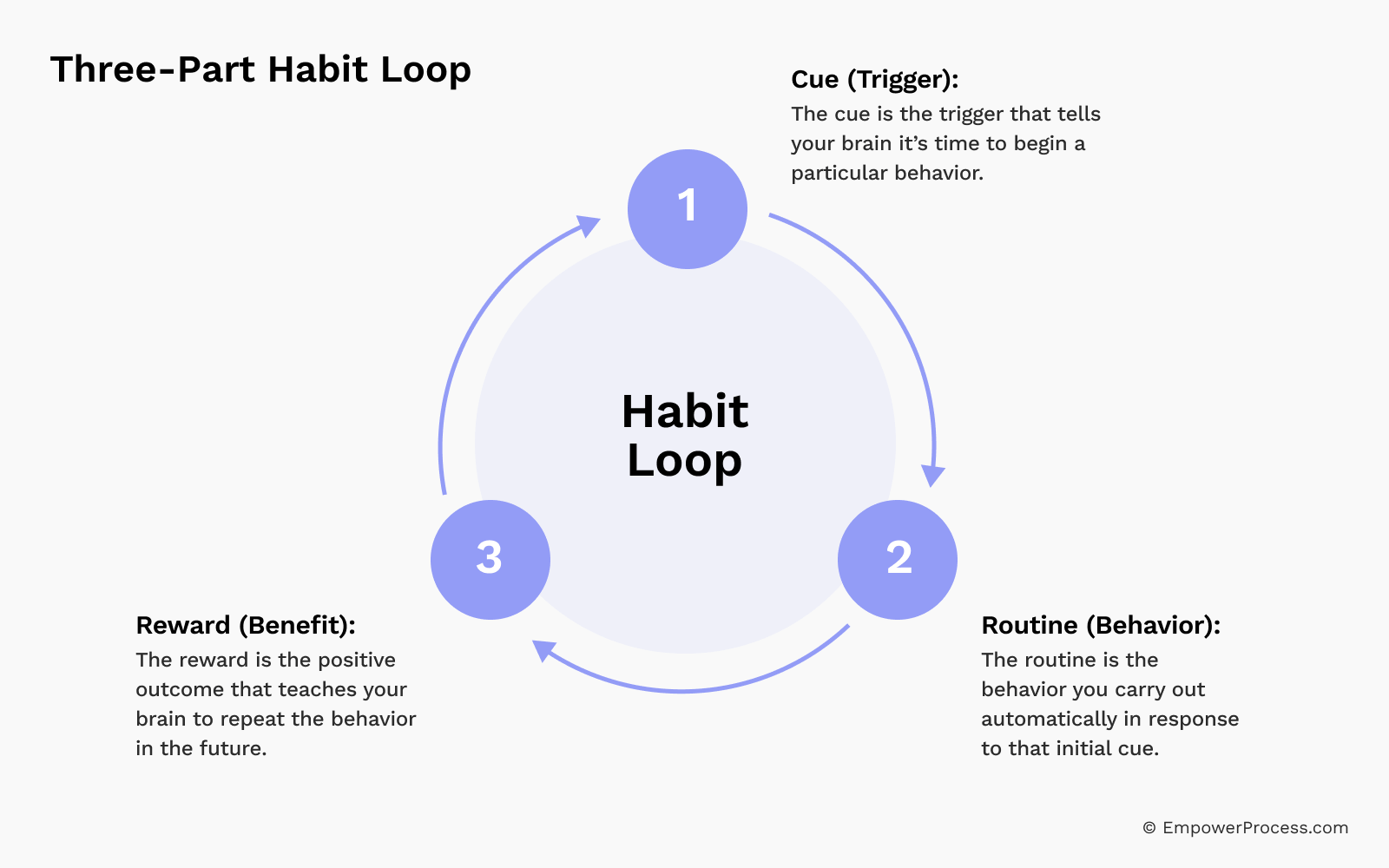
Every habit follows the same three-part neurological pattern. Here’s what neuroscience reveals: MIT’s McGovern Institute for Brain Research has mapped how habits form in unprecedented detail. And it’s not complicated. Whether it’s checking your phone first thing in the morning or automatically reaching for unhealthy snacks, every habit follows the same three-part loop.
Understanding this loop is where change begins. Not willpower. Not motivation. Not guilt. Just clarity.

The Three-Part Habit Loop Explained
- Cue (Trigger): The event or situation that initiates the habit. Example: You finish lunch and feel the afternoon slump.
- Routine (Behavior): The actual habit or action you perform. Example: You reach for a sugary snack or double shot of espresso.
- Reward (Benefit): The positive feeling or outcome that reinforces it. Example: Temporary energy boost and mood lift.
Here’s the thing: your brain doesn’t care if the habit is good or bad. It just cares that the reward satisfies the craving triggered by the cue. So when you feel that afternoon slump (cue), you grab a snack (routine) and feel temporarily better (reward). Your brain remembers this chain and automates it.
Three Ways to Interrupt the Loop
Option 1. Identify Your Triggers Ruthlessly.
Spend one week tracking when, where, and why your unwanted habits happen. Research shows this awareness alone reduces habit frequency by 30%. Write down: What time? Where were you? What emotion came before it? This isn’t punishment—it’s data.
Option 2. Understand What Reward You’re Actually Seeking.
Most people misidentify rewards. You don’t crave the cigarette; you crave the break from stress. You don’t want the junk food; you want the comfort or energy. Once you know the real reward, you can find healthier ways to get it. This is crucial.
Option 3. Use “Implementation Intentions”.
Instead of vague goals, use specific if-then planning. Behavioral psychology studies shows this approach greatly increases success rates. Example: “If I feel the afternoon slump, then I will take a 5-minute walk instead of reaching for a snack.”
How Habits Form: What Research Shows
Habit formation happens through repeating simple actions in a stable context, allowing environmental cues to trigger the behavior automatically. This reduces the need for conscious effort or motivation, according to research.
A systematic review found that habit-building interventions produce moderate-to-large improvements in healthy behaviors. Simple habits like drinking water tend to form faster than complex behaviors like exercise or diet changes, as shown in multiple studies.
On average, habits take about 66 days to become automatic, with a broad range from 18 to 254 days. Data shows that some habits may take up to 91 days to form, disproving the “21-day rule.”
People who choose their own habits tend to form them more effectively. Morning habits also develop stronger than evening ones, with studies showing habit formation medians of 59–66 days and means of 106–154 days, depending on behavior type.
Simple, repetitive behaviors—like daily flossing—reach automaticity faster than complex actions like exercise routines. Research also shows that rewards and a consistent environment help habits stick.
Key Takeaway: The habit loop isn’t something that happens to you—it’s something you can redesign. Understanding your triggers and the rewards you’re actually seeking gives you the power to intervene strategically.
Creating and Building New Habits
Most people fail because they make new behaviors too hard. Let’s get real: you try to go from zero to running 5 miles daily. Of course that fails. Nobody sustains what feels impossible.
The solution? Apply the four principles that behavioral science has proven work.

The Four Laws of Habit Formation
Law 1: Make It Obvious
Your environment shapes your behavior far more than you realize. If you want to read more, put the book on your pillow. If you want to exercise, lay out your gym clothes the night before. Visual cues bypass the decision-making part of your brain and trigger automatic behavior.
Law 2: Make It Attractive
This is where “temptation bundling” comes in. Pair something you struggle to do with something you already enjoy. Only listen to that podcast you love while exercising. Only drink your favorite tea during your morning journaling. Research shows this technique increases adoption rates by up to 45%.
Law 3: Make It Easy
Here’s where most people get stuck. They design habits that are too ambitious. Instead, start with the 2-minute version. Not “run 5 miles.” Just “put on running shoes.” Not “meditate for 30 minutes.” Just “sit and breathe for 2 minutes.” The goal isn’t to accomplish the full habit on day one. It’s to build the neural pathway. Complexity comes later.
Law 4: Make It Satisfying
Your brain reinforces behaviors that feel immediately rewarding. So you have to create immediate satisfaction. Check a box on a habit tracker. Use a habit app that shows your streak. Write in a journal. That visual proof of progress is more powerful than you’d think.
Common Myths About Habit Building
| The Myth | The Reality |
|---|---|
| “Habits take 21 days to form” | It takes an average of 66 days, with ranges from 18-254 days depending on complexity |
| “More motivation = more success” | Environment design and strategic implementation beat motivation every time |
| “You need to go big or go home” | Small 2-minute habits compound faster and stick better than ambitious goals |
| “One slip-up means you’ve failed” | Missing once is a lapse; missing twice is the start of a new pattern. One miss doesn’t reset you |
The Implementation Intention Formula
Here’s your actionable framework. Use this exact structure for any habit you want to build:
“After [existing habit], I will [new habit].”
- After I pour my morning coffee, I will write three things I’m grateful for.
- After I close my laptop for the day, I will do 10 minutes of stretching.
- After I eat lunch, I will take a 10-minute walk.
This works because you’re leveraging a habit that’s already automated. Your brain already knows “pour coffee.” Now you’re just attaching a new behavior to it. This is called “habit stacking,” and it’s one of the most effective techniques in behavioral psychology.
Key Takeaway: Strategic implementation beats willpower. Make new habits obvious, attractive, easy, and immediately satisfying. Start small. Use habit stacking to leverage existing behaviors. Track your progress visually.
Breaking Bad and Unwanted Habits
Replace your bad habits, don’t just remove them. Here’s what happens when you try to just “stop” a habit: your brain revolts. You’re left with a vacuum where the reward used to be. That’s why willpower-based approaches fail so spectacularly. You’re fighting your own neurology.
The secret? You don’t eliminate habits. You replace them.

The Habit Replacement Strategy
Let’s say you want to stop the afternoon coffee habit that leaves you wired and unable to sleep. Don’t just “stop drinking coffee.” Instead:
Step 1: Identify the Real Trigger and Reward
The trigger isn’t coffee. It’s the afternoon slump. The reward isn’t caffeine—it’s the energy boost and the mental break. Once you know this, you can replace the behavior while keeping the reward.
Step 2: Design a Healthier Replacement
Instead of afternoon coffee, take a 5-minute walk or do 10 jumping jacks. Both provide the energy and mental break without the sleep disruption. The cue stays the same. The reward stays the same. Only the routine changes.
Step 3: Make the Replacement Easier Than the Original
If your coffee machine is 10 steps away, but your sneakers are on your desk, you’ll reach for the shoes. This is environment design. Make the replacement behavior the path of least resistance.
Research shows replacement habits are 50% more likely to stick than pure elimination attempts. Your brain gets the reward it needs. You break the limiting behavior. Win-win.
Five Practical Strategies for Breaking Habits
1. The Habit Diary Method
For one week, document every time the unwanted habit happens. Note the time, location, what you were doing, and how you felt. This awareness itself reduces habit frequency by 30%. Plus, you’ll spot patterns you didn’t notice.
2. Increase Friction for Bad Habits
Make the unwanted behavior harder. Delete the app from your phone’s home screen (not your phone—just the home screen). Store snacks in opaque containers instead of transparent ones. Research on decision fatigue shows that even small friction increases significantly reduce habit execution.
3. Leverage Social Accountability
Tell someone your goal. Studies show accountability partnerships increase habit-breaking success by 65%. It doesn’t have to be intense—just someone who checks in with you weekly.
4. Use the “Pause and Observe” Technique
When the urge hits, pause for 2 minutes before acting. Just observe the urge without judgment. Notice: where do you feel it in your body? Does it intensify or fade? Most urges peak and then decline within 15 minutes if you don’t feed them. This single technique rewires your response.
5. Design Your Environment for Success
Remove or hide environmental triggers. If you snack mindlessly while scrolling, put your phone in another room during snack times. If you overspend online, delete saved payment methods. You’re not relying on willpower; you’re removing temptation.
Key Takeaway: Breaking habits isn’t about willpower—it’s about replacement and environmental design. Identify the real trigger and reward. Design a healthier replacement that provides the same reward. Make the replacement easier than the original. Use accountability and environment manipulation to stack the odds in your favor.
Tracking Your Habit Building Progress
You can’t improve what you don’t measure. Seeing progress is one of the most underrated motivators. It feels good to check a box. It feels even better to see a 30-day streak.

Three Tracking Methods That Actually Work
The Simple Calendar Method
Print a calendar. Each day you complete your habit, mark an X. Try not to break the chain. It sounds basic, but the visual chain is incredibly motivating—and there’s science behind it. Tracking completion rates increases consistency by 28%.
The Habit Scorecard
Rate your daily execution on a scale of 1-10. On days you score 8+, reflect on why. On days you score below 5, ask: what got in the way? This isn’t about judgment—it’s about pattern recognition. You’ll notice that certain conditions (sleep, stress levels, time of day) affect success.
The Accountability Partnership
Share your commitment with someone. Weekly check-ins where you report your progress. Not as punishment—as celebration. Even if you only hit 70%, that’s still 70% better than zero. Accountability shifts the dynamics: now you’re not just doing this for yourself; you’re doing it with support.
Key Takeaway: Visible progress compounds motivation. Choose one tracking method and stick with it for 30 days. Track not just completion, but also the conditions that support success. Share your progress with someone.
30-60-90 Day Habit Transformation
This is where knowledge turns into progress. Follow this three-phase plan to build habits that stay with you for the long run.

First 30 Days: Foundation and Awareness
Weeks 1-2: Habit Mapping
- Create a detailed Habit Scorecard of current behaviors
- Identify one keystone habit to build and one to break
- Begin daily habit tracking in a dedicated journal
- Set up environment for success (remove triggers for bad habits, create triggers for good ones)
Weeks 3-4: Implementation
- Start with 2-minute versions of desired habits
- Practice habit stacking with existing routines
- Document triggers and rewards for existing habits
- Begin using replacement behaviors for unwanted habits
Success Markers: Complete habit inventory, establish daily tracking system, implement three environment changes, achieve 80% success rate with 2-minute habits.
Days 31-60: Strengthening and Expansion
Weeks 5-6: Habit Enhancement
- Gradually increase complexity of new habits
- Implement reward systems for consistency
- Start accountability partnerships
- Add one new habit stack
Weeks 7-8: Challenge Integration
- Test habits under different conditions
- Develop contingency plans for obstacles
- Create support systems for difficult situations
- Begin mentoring others in habit formation
Success Markers: 85% consistency in habit execution, established accountability system, documented strategies for common obstacles, successful navigation of two challenging situations.
Days 61-90: Mastery and Integration
Weeks 9-10: Advanced Implementation
- Fine-tune habit systems based on data
- Develop more complex habit chains
- Create long-term maintenance strategies
- Begin experimenting with new habit areas
Weeks 11-12: Lifestyle Integration
- Solidify habit tracking systems
- Create recovery protocols for setbacks
- Design next phase of habit development
- Establish long-term success metrics
Success Markers: 90% habit consistency, automated tracking system in place, clear progression plan, robust maintenance strategy.
Start Your New Habits Today
Imagine waking up six months from now with your good habits running on autopilot. Your mornings feel smooth, healthy choices feel easy, and things that once felt hard now come naturally. This isn’t a fantasy—it’s what happens when you apply the basics of habit science.
Small habits create big ripple effects. Each one builds on the next, shaping your days and ultimately your life.
Your Next Step
- Pick one small habit to start tomorrow
- Decide exactly when and where you’ll do it
- Set up your environment tonight so it’s easy to follow through
Remember: changing your habits means changing your life. Small actions add up faster than you think. Start small, but start today—your future self will thank you.
Frequently Asked Questions
How long does it actually take to build a new habit?
Most habits take longer than people think. Research shows the average is about 66 days, but the real timeframe depends on the complexity of the behavior. Some habits form in a few weeks, while others take several months. What matters most is consistency—small, repeatable actions done daily create the neural pathways that make habits automatic.
What is the habit loop and how does it affect my daily behavior?
The habit loop is a simple three-part cycle: cue, routine, and reward. A cue triggers your behavior, the routine is the action you take, and the reward reinforces it. Understanding this loop helps you see why certain habits feel automatic. Once you identify your cues and rewards, you can intentionally redesign the routine to build better habits or break limiting ones.
What’s the most effective way to break a bad habit?
Breaking a habit isn’t about forcing yourself to stop—it’s about replacing the routine with a healthier one. Keep the same cue and reward, but swap in a different behavior that meets the same need. This approach works better than willpower because your brain still gets the reward it expects, making the new routine far easier to maintain long-term.
How can I make new habits easier to stick to long term?
Make habits obvious, attractive, easy, and satisfying. Start with a very small version—just two minutes—to lower resistance. Use habit stacking by linking the new action to something you already do. Track your progress visually, celebrate small wins, and design your environment to support the behavior. These simple tools help your brain automate the habit over time.
What is a habit plan and how can I use it to transform my routines?
A 90-day habit plan guides you through three phases: building awareness, strengthening your routines, and integrating habits into your lifestyle. You start small, track your progress, refine your environment, and gradually increase complexity. Ninety days is long enough to form strong neural pathways but short enough to stay motivated. By following the phases, new habits become more automatic and sustainable.
Related articles
The Art of Effective Goal Setting and Achievement
Align your habits with meaningful goals that matter.
Building Confidence and Self-Esteem: Simple Steps for Lifelong Empowerment
Each completed habit builds unshakable confidence.
The Role of Failure in Personal Growth: Learning from Setbacks
Turn habit slip-ups into data for improvement, not failure.
Mastering Self-Discipline: The Key to Achieving Your Goals
Self-discipline is built, not born—through consistent small actions.
The Power of Momentum: How Small Wins Lead to Big Success
See how individual habits compound into unstoppable momentum.
Further reading
Atomic Habits by James Clear
The essential guide to tiny habits that create remarkable results.
The Power of Habit by Charles Duhigg
Neuroscience meets real-world case studies of lasting habit change.
Tiny Habits by BJ Fogg
Start smaller than you think. Behavioral science made practical.
How to Change by Katy Milkman
Overcome the psychological barriers holding your habits back.
The Miracle Morning by Hal Elrod
Build morning habits that transform your entire day.