
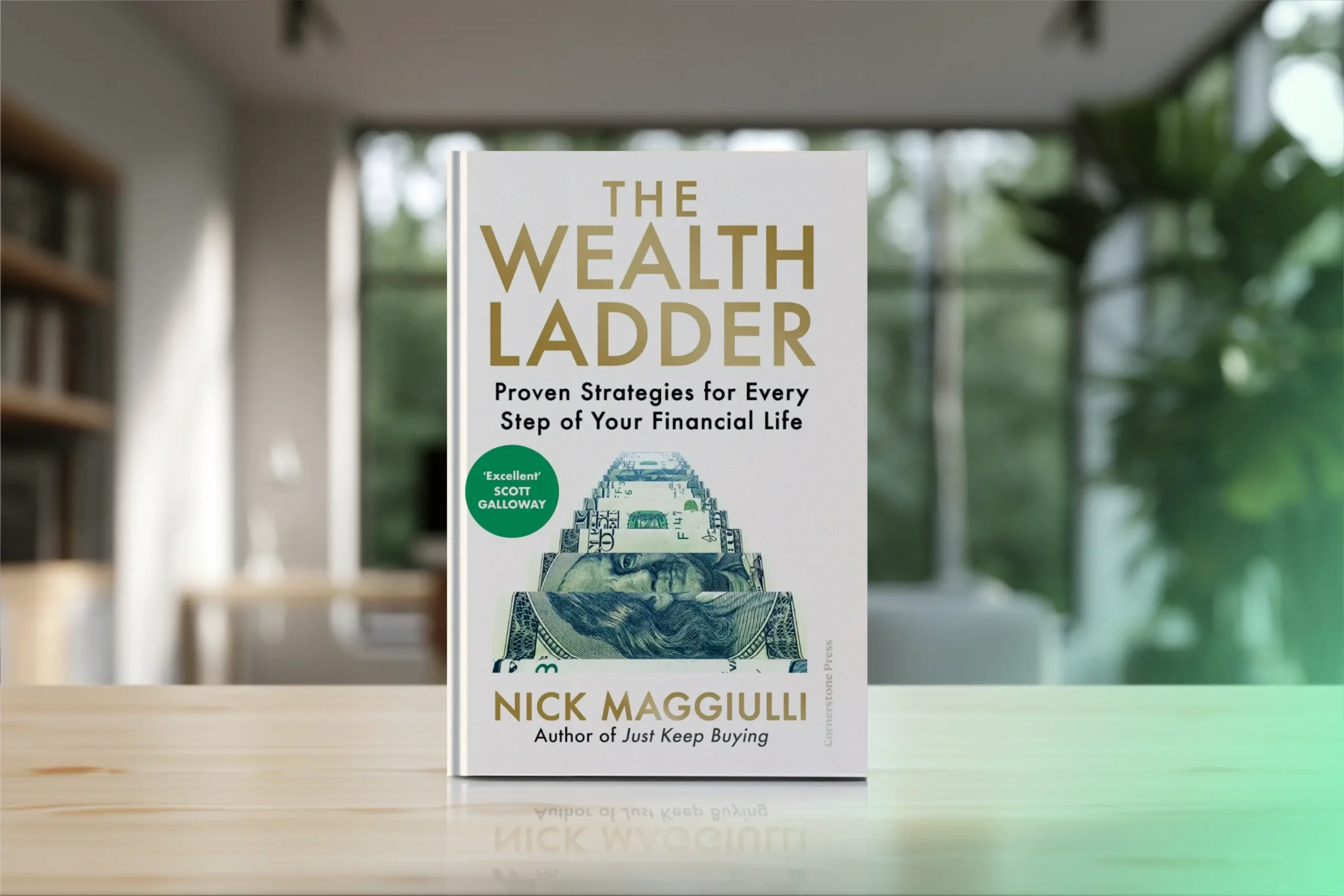
Nick Maggiulli‘s The Wealth Ladder introduces a six-level framework that redefines how you think about money, showing that the financial strategy that gets you to one level of wealth won’t be the same one that takes you to the next, first published in 2025.
The bestselling author of Just Keep Buying, Maggiulli brings rigorous data analysis and real-world financial expertise to every page.
Core Concepts
The book introduces several key ideas that form the foundation of Nick Maggiulli’s theory:
- Six Wealth Levels: Net worth ranges from under $10,000 to $100 million+, each requiring a different financial approach.
- Lifestyle Freedoms as Milestones: Each level unlocks a spending freedom, from grocery freedom to travel freedom to impact freedom, turning abstract numbers into real progress markers.
- The 0.01% Rule: A simple spending heuristic that anchors purchasing decisions to your net worth, so your perception of money evolves as wealth grows.
- Spend, Earn, Invest Framework: Every wealth level is examined through three lenses: how to spend wisely, grow income and invest effectively, creating a consistent decision making structure.
- Types of Leverage: As wealth increases, available leverage expands from labour and capital to content and code, unlocking scalable paths to income and growth.
Together, these ideas form a practical system that grows with you, not a one time read but a framework you can revisit at each new stage of your financial life.
Chapter-by-Chapter Review
Chapter 1: The Case for a Wealth-Based Framework
This section introduces the idea that wealth should be understood in stages rather than as a single continuous journey. Maggiulli explains why income alone is not enough to determine financial behavior, and why net worth is a better anchor for decision-making.
Chapter 2: The Six Wealth Levels
Here, the six wealth levels are introduced and defined:
- Under $10,000
- $10,000–$100,000
- $100,000–$1 million
- $1 million–$10 million
- $10 million–$100 million
- $100 million+
Each level is paired with a corresponding lifestyle freedom, making financial progress feel tangible, meaningful, and easier to appreciate rather than abstract.
Chapter 3: Lifestyle Freedom as a Measure of Progress
This section expands on the idea that financial progress is best understood through what money allows you to do. Instead of focusing only on numbers, Maggiulli links each stage to real-life freedoms such as stability, discretionary spending, travel flexibility, and ultimately influence.
Chapter 4: The 0.01% Rule and Spending Behavior
Maggiulli introduces the 0.01% Rule as a mental model for evaluating spending decisions relative to net worth. The focus here is behavioral: how your perception of money should change as your wealth increases, and why certain purchases become “mathematically insignificant” at higher levels.
Chapter 5: Spending at Each Wealth Level
This chapter moves through how spending behavior should evolve across the ladder. At lower levels, the emphasis is on control and survival. In the middle, it shifts toward balance and lifestyle design. At higher levels, spending becomes less about constraint and more about intentionality.
Chapter 6: Earning and Increasing Income
Here, the book focuses on income growth. Maggiulli breaks down different forms of earning power and how they shift over time:
- Early stage: labor and skill development
- Middle stage: career leverage and compounding expertise
- Later stage: business ownership, capital, and scalable systems
The key message is that earning power is the foundation of climbing the ladder.
Chapter 7: Investing and Capital Growth
This section covers how investment strategy evolves with wealth. Early investors are encouraged to focus on consistency and index investing. As wealth grows, capital allocation and risk management become more important than aggressive accumulation.
Chapter 8: Forms of Leverage
Maggiulli expands on leverage as the mechanism that accelerates wealth building:
- Labor (your own time and effort)
- Capital (money working for you)
- Code (software and systems)
- Content (media and scalable influence)
The key idea is that higher wealth levels unlock access to more powerful forms of leverage.
Chapter 9: Wealth, Utility, and Diminishing Returns
This chapter steps back from mechanics and looks at what money actually does for wellbeing. Maggiulli discusses diminishing returns of wealth and how additional money has less emotional impact as net worth increases.
Chapter 10: Using the Wealth Ladder in Real Life
The final section ties everything together. Readers are encouraged to identify their current level, focus only on the relevant strategies, and revisit the framework over time as their situation changes. The ladder is presented not as a goal, but as a tool for decision-making.
Key Strengths
- Contextualised Advice: Tailors financial guidance to your specific wealth level rather than offering vague, one-size-fits-all rules.
- Data-Driven Rigour: Draws on Federal Reserve surveys, historical market data, and Maggiulli’s own analysis to back every major claim.
- A Framework You Can Revisit: Designed to be reread at each new financial stage, making it one of the few personal finance books with genuine long-term utility.
- Holistic Coverage: Integrates spending, earning, and investing into a single coherent system rather than treating them as separate topics.
- Modern Relevance: Incorporates contemporary income paths like content creation and software, grounding the book firmly in today’s economic reality.
Potential Drawbacks
- Upper Levels Feel Out of Reach: Chapters focused on $10M+ net worths will feel aspirational rather than actionable for the majority of readers.
- Repetitive Structure: The spend-earn-invest formula applied to each level can feel formulaic by the midpoint of the book.
- US-Centric Tax and Investment Detail: Some sections reference US-specific financial products and tax rules that international readers will need to adapt.
Who This Book Is For
This book is a valuable resource for a wide range of readers, particularly:
- Personal finance readers who prefer evidence-based, data-driven advice over motivational storytelling
- Young professionals looking for a structured, stage-by-stage roadmap to building wealth
- Investors who want guidance that evolves as their financial situation changes
- Fans of Just Keep Buying who want a broader framework for managing and growing wealth across every stage of life
Final Review
“The Wealth Ladder” is one of the most practically structured personal finance books in recent years. Maggiulli’s core insight, that the right financial move depends entirely on where you are right now, sounds obvious once stated, yet most advice books completely ignore it. The result is a guide you can open at any stage of your financial journey and immediately find something useful. Readers who enjoyed Just Keep Buying will recognise the analytical clarity here, expanded into a broader, more adaptable roadmap.
Rating: 4.6/5
A rare personal finance book that meets you where you are and grows with you, rigorous, practical, and built to last.
Alternative Books
Here are three related books that further explore this topic:
“Just Keep Buying” by Nick Maggiulli
Maggiulli’s debut data-backed guide to saving and investing that demolishes the myths holding most people back from building wealth.
Rating: 4.6/5
“The Psychology of Money” by Morgan Housel
Morgan Housel’s exploration of how behaviour and mindset shape financial outcomes — the essential companion to any data-driven wealth framework.
Rating: 4.7/5
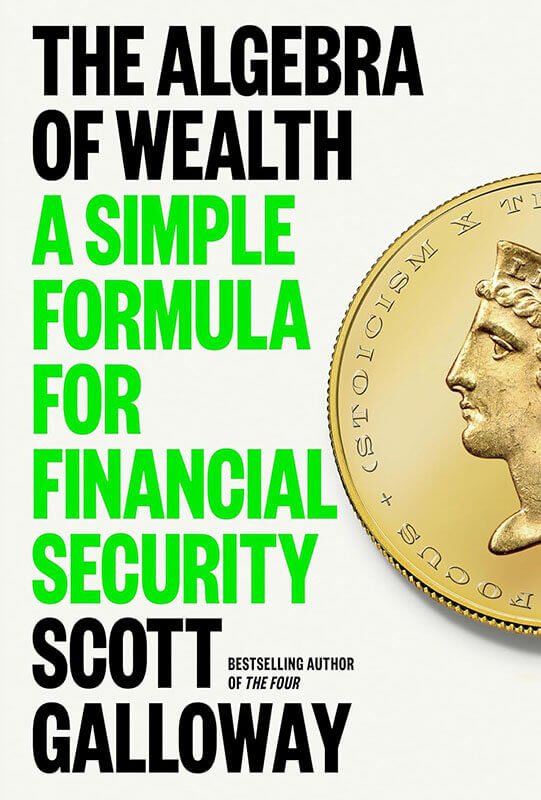
“The Algebra of Wealth” by Scott Galloway
Scott Galloway’s four-factor framework for building economic security is a bold, candid counterpart to Maggiulli’s ladder approach.
Rating: 4.6/5